
Why Won't My Car Start?
By Adam, Certified Mobile Mechanic
Short answer: the way your car fails to start tells you where to look. No lights and one click usually means a dead battery or a bad starter. Lights work but the engine cranks without firing usually means fuel or ignition. A car that ran fine, then died and won't restart, often points to the alternator. Below is how to read each of those before you call anyone.
A no-start is stressful, especially when you are already late and parked somewhere inconvenient. The good news is that you can narrow the cause down in about a minute, just by paying attention to what happens when you turn the key. Here is how to tell the common causes apart.
Nothing happens, or you hear a single click
If the dash goes dark, the lights are weak, or you hear one click and nothing else, the problem is almost always electrical. Start with the battery.
- Dead or weak battery: the most common cause by far, especially after cold nights, a few weeks of short trips, or leaving a light or door ajar overnight. Dim or dead interior lights when you open the door are a giveaway.
- Corroded or loose battery terminals: even a healthy battery cannot deliver power through a crusty or loose connection. White or green buildup on the terminals is a clue.
- Failing starter: if the battery is clearly good but you only get a single loud click, the starter motor or its solenoid may not be engaging.
A battery is often a quick fix. We carry quality batteries and can test and replace one on-site, usually in under 30 minutes. See our mobile battery replacement if that turns out to be the culprit.
It cranks but does not catch
If the engine turns over normally, that healthy "rur-rur-rur" sound, but never fires up, your electrical system is fine and the issue is usually fuel or ignition.
- No fuel: a failing fuel pump, a clogged filter, or simply an empty tank or a stuck gauge. If you hear no faint hum from the tank when you turn the key to "on," the pump is worth checking.
- Ignition trouble: worn spark plugs, a failing ignition coil, or a crank or cam sensor that is not telling the computer when to fire.
- Security or immobilizer fault: some cars refuse to start if the key or fob is not recognized. A flashing security light on the dash points this way.
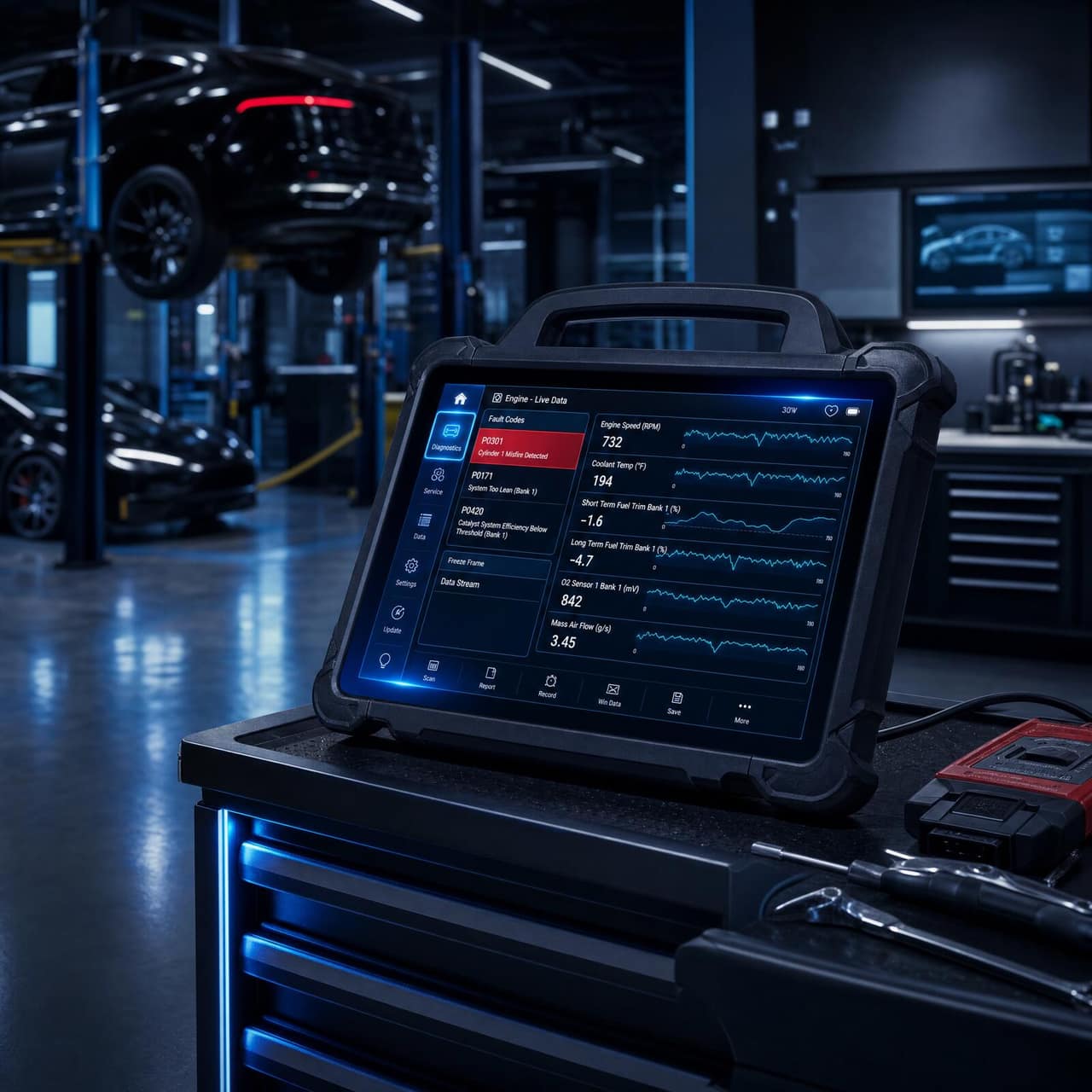
These overlap, so they need a proper diagnosis rather than a guess. Our mobile diagnostics service uses factory-level scan tools to read the codes and live data and pinpoint the real cause, instead of throwing parts at it and hoping.
It started fine, then died and won't restart
If the car ran, then quit while driving and will not come back, and especially if the battery light was on before it died, the charging system is the strong suspect. A failing alternator can slowly drain the battery as you drive until there is not enough power left to keep the engine running or to restart. If that sounds familiar, read our guide on the signs of a failing alternator.
Battery, starter, or alternator: pinning down an electrical no-start
These three are the usual suspects in an electrical no-start, and they cause similar symptoms, which is exactly why guessing leads to replacing the wrong part. A clicking no-start often points to the battery or starter; dimming lights and a charging warning usually mean the alternator. The only reliable way to know is to test the whole circuit: battery health, alternator output, and starter draw. We test all three on every no-start call before replacing anything, so you never pay for a part that was working fine.
A quick checklist before you call
- Try the headlights and interior lights. Weak or dead points to the battery or a connection.
- Listen carefully when you turn the key. One click usually means battery or starter; steady cranking points to fuel or ignition; total silence can mean a security or neutral-safety issue.
- Check that the car is fully in Park, then try again in Neutral. A worn shifter or neutral-safety switch can block the start.
- Look for an obvious cause: lights left on, a loose or corroded battery cable, or an empty tank.
- Note anything that happened right before. A dashboard battery light, a recent jump start, or a slow crank all narrow it down fast.
The more of this you can tell us when you call, the faster we can arrive with the right part on board.
How a mobile mechanic diagnoses a no-start
When we arrive, we work the circuit in order rather than guessing. We load-test the battery, check the terminals and grounds, measure alternator output, and test the starter draw. If the engine cranks but will not fire, we move to fuel pressure, spark, and a scan-tool read of the crank and cam sensors and any stored codes. Within a short visit you get a clear answer on what failed, an upfront price to fix it, and, in most cases, the repair done on the spot.
We come to you
Most no-starts do not need a tow. We are fully mobile across Flushing, Queens, Brooklyn, Long Island, and the rest of NYC, so we bring the tools and parts to wherever your car is stuck, diagnose the real problem, and in most cases fix it right there. We are available 24/7, so a no-start at 6 a.m. or on a Sunday is no problem. Text us and we will usually reply in under 5 minutes.
To narrow it down yourself first, battery, starter, or alternator has a table matching what you hear when you turn the key to the part that is usually responsible. If the car is clicking, what the clicking means separates rapid clicking from a single click, and how to tell if the starter is bad covers the case where the dash lights stay bright.
Need a hand with this?
We come to you across Flushing & Queens and the rest of NYC. Text us and we typically reply in under 5 minutes, with a free upfront quote before any work begins.